Newly Diagnosed? We’re happy to help, but sorry you’re here.
For more than 30 years, I’ve walked alongside individuals and families facing a new NF diagnosis, and I’ve lived it personally, too. I’ve received a new diagnosis twice with my children when they were babies, and I’ve learned deeply from my husband’s experience of being diagnosed with NF at age 18.
Those experiences, both my own and those shared with me by so many in our community, have taught me something that matters deeply: there is no single “right” way to experience or respond to a new diagnosis.
Some people want to learn everything they can right away and be involved in every decision. Others find comfort in moving more slowly by focusing on day‑to‑day life, not worrying about what may or may not happen, and giving themselves time to adjust. Most fall somewhere in between, and all of those approaches are valid.
Whatever your path looks like, a new diagnosis of neurofibromatosis type 1 (NF1), NF2‑related schwannomatosis (NF2‑SWN), or other schwannomatosis (SWN) can bring a wave of questions and emotions. Please know this: you are not alone.
NF Midwest is a community of individuals and families who have been where you are. We are here to support you, whenever and however you need us.
Below are a few gentle pieces of guidance I’ve gathered over the years from listening to and learning from our community.
NF Midwest was built by people personally affected by NF, for people affected by NF. We understand the journey ahead and are dedicated to providing the resources, support, and hope you need.
“Finding NF Midwest felt like a huge weight was lifted off my shoulders. Suddenly, we weren’t alone anymore. We had a whole community that just ‘got it.’ Their guidance has been invaluable.”
Sarah, Mom of a newly diagnosed child
A Few Things We’ve Learned Along the Way
Give yourself permission to slow down. There is an old saying: don’t borrow trouble. NF can bring a lot of unknowns, and it’s easy to worry about things that may never happen. Worrying ahead of time doesn’t protect you—and many of the fears that surface early on never come to be.
If you have a young child with NF, preparation can help you feel grounded and empowered. Think of it like preparing your home for a baby or toddler. You don’t stop living your life—you simply become a little more watchful. You baby‑proof outlets, gate the stairs, and learn what to look for. NF is similar: with awareness and routine care, most things are manageable, and preparation often brings peace of mind.
Understanding NF is important, but it’s also important to remember that NF—especially NF1—varies widely from person to person. You don’t need to worry about everything you read. Focus on learning what’s relevant now, and build knowledge over time. This can be especially helpful if you don’t always have access to NF‑specific specialists and rely on primary care providers who may not see NF often.
If and when it feels right, connecting with others can be incredibly reassuring. Hearing real‑life experiences often feels far less scary than what you might read online. One of the greatest benefits of community is hindsight—learning from people who have already walked this path and hearing what they wish they had known or done differently. That shared perspective can be both comforting and empowering.
Online groups and social media can be a powerful way to connect and feel less alone—but it helps to understand the lens. People who are struggling or facing complications are often more active and more likely to post. Individuals who are mildly affected, or whose children are mildly affected, tend to be less visible.
This can unintentionally make NF seem more frightening than it often is. Social media can be helpful, but it’s important to balance what you read online with medical guidance and real‑world perspective.
When You’re Ready, 5 Steps to Begin Your Journey
Fill out our form to ensure that you receive timely news updates, research updates, invitations to events, and more. Also, request a free packet of iNFo if you like.
Connecting with others who understand can make all the difference. Join our private Facebook group, online and community conversations, educational opportunities, and supportive peers.
Gain a better understanding of neurofibromatosis and schwannomatosis, including the different types and what to expect. We break down complex information into easy-to-understand resources.
Explore the options we have for actively learning and getting community support through our in-person and online programs.
Whether it’s fundraising, spreading awareness, participating in research, or giving in other ways, there is a lot you can do to further the cause.
Contact Diana to Talk or Be Connected with Someone Else.
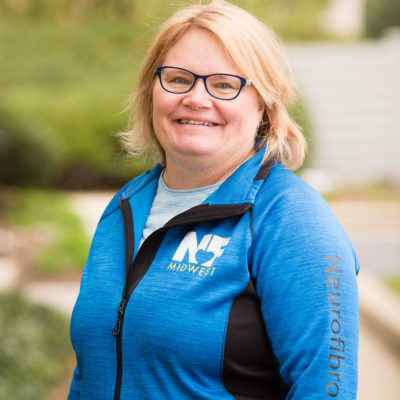
If you ever have questions or just want to talk, please don’t hesitate to reach out. I make time to connect one‑on‑one whenever I can, and if it’s helpful, I can also connect you with another individual or parent who’s been there.
Diana
Email: diana@nfmidwest.org
Phone: 630.945.3562 Ext 1